How To Calculate Proportionality Constant . 24 = k (3) k = 24 ÷ 3 = 8. We know that y varies proportionally with x. PPT Constant of Proportionality! PowerPoint Presentation, free from www.slideserve.com Generally, the constant proportionality calculator plays an important role to find the constant of proportionality in the physics, mathematics, and engineering fields. 30 = k (3) 10 = k. You see 1/2 is equal to k here, pi is equal to k right over there.
Simpson's 1/3 Rule Calculator. To approximate a definite integral using simpson’s rule, utilize the following equations: It is known as simpson's 3/8 rule;
PPT Numerical Methods Part Simpson Rule For Integration from www.slideserve.com
∫ ab f (x) dx = h/3 [ (y 0. The formula for numerical integration using simpson’s rule is: Simpson's 1/3 rule gives a more accurate approximation.
∫ Ab F (X) Dx = H/3 [ (Y 0.
First we calculate value of δx. Simpson's 1/3 rule gives a more accurate approximation. After reading this chapter, you should be able to.
It Is Calculated By Increasing The Number Of Partitions To Double From 2 To N.
Provide step by step solutions of your problems using online calculators (online solvers) problem source: 1.) a r e a = δ x 3 [ f ( a) + 4 f ( a + δ x) + 2 f ( a + 2 δ x) + ⋯ ⋯ + 2 f ( a + ( n − 2) δ x) + 4 f ( a + ( n − 1) δ x) + f ( b)] 2.) δ x = b − a n. In order to integrate any function f (x) in the interval (a, b), follow the steps.
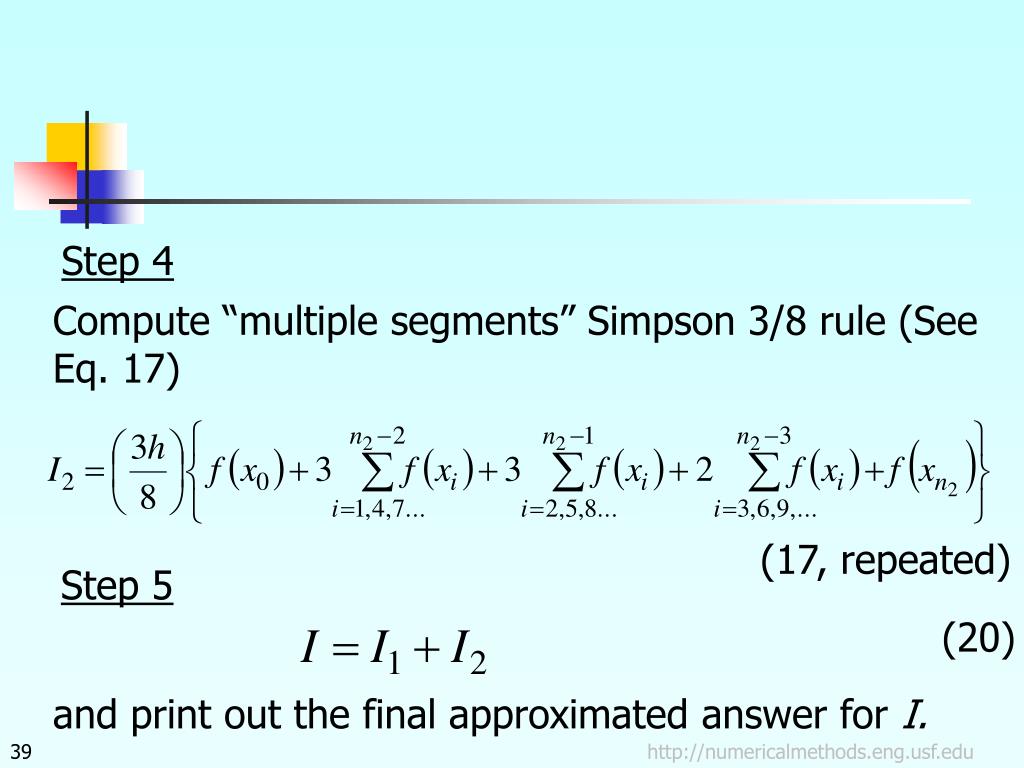
Simpson's 3/8 Rule Is Similar To Simpson's 1/3 Rule, The Only Difference Being That, For The 3/8 Rule, The Interpolant Is A Cubic Polynomial.
Simpson's 1/3, simpson's 3/8 rule 1. The basic idea is to. In this section, we will discuss both of these simpson's rules and will also implement the example code of both the rules.
Area Calculation Results Are Then Considered For Volume Computation.
To approximate a definite integral using simpson’s rule, utilize the following equations: Using simpson's rule with n=4; Here are the steps that explain how to apply simpson's rule for approximating the integral b ∫ₐ f(x) dx.
Simpson's 1/3 Rule Algorithm 1.
S =∫ b a f(x)dx= h 3{f(a)+2n 2−1 ∑ j=1 f(a+2jh)+4 n 2 ∑ j=1f(a+(2j−1)h)+f. In the source code below, a function f (x) = 1/ (1+x) has been defined. Identify the values of 'a' and 'b' from the interval [a, b], and identify the value of 'n' which is the number of subintervals.


Comments
Post a Comment